Lo! he comes with clouds descending, once for favored sinners slain; thousand, thousand saints attending swell the triumph of his train. Alleluia! Alleluia! Alleluia! God appears on earth to reign.
Evry eye shall now behold him, robed in dreadful majesty; those who set at naught and sold him, pierced, and nailed him to the tree, deeply waning deeply waning shall the true Messiah see.
Those dear tokens of his Passion still his dazzling body bears, cause of endless exultation to his ransomed worshippers: with what rapture…with what rapture… gaze we on those glorious scars!
Yea, amen! let all adore thee, high on thine eternal throne; Savior take the power and glory, claim the kingdom for thine own. O come quickly, O come quickly; Alleluia! come, Lord, come. Amen
When the perishable puts on the imperishable, and the mortal puts on immortality, then shall come to pass the saying that is written: “Death is swallowed up in victory.”
“O death, where is thy victory? O death, where is thy sting?” The sting of death is sin, and the power of sin is the law. But thanks be to God, who gives us the victory through our Lord Jesus Christ.
Therefore, my beloved, be steadfast, immovable always abounding in the work of the Lord, knowing that in the Lord your labor is not in vain.
The Annunciation heralds the dawn of our salvation. At Mary’s obedient fiat all humanity is wedded to the Divine. The salvation our heart cries out for every day became flesh in the womb of Mary our Mother. We are Christians because of what God announced to Mary : “Hail, full of Grace! the Lord is with you … Do not be afraid Mary, for you have found favor with God” ( Luke 1:26 )
Be it done unto me according to your word the virgin Mary whispers. And at that moment the Eternal Word became flesh and dwelt among us. And this living word embodies the gift of redemption. It will mean for all people in all times unending union with Him and his Father.Eternal Life for all who believe in Jesus Christ our Lord..
Source Magnificat
.
The angel awaits an answer; it is time for him to return to God who sent him. We too are waiting, O Lady, for your word of compassion; the sentence of condemnation weighs heavily upon us.
The price of our salvation is offered to you. We shall be set free at once if you consent. In the eternal Word of God we all came to be, and behold, we die. In your brief response we are to be remade in order to be recalled to life.
Tearful Adam with his sorrowing family begs this of you, O loving Virgin, in their exile from Paradise. Abraham begs it, David begs it. All the other holy patriarchs, your ancestors, ask it of you, as they dwell in the country of the shadow of death. This is what the whole earth waits for, prostrate at your feet. It is right in doing so, for on your word depends comfort for the wretched, ransom for the captive, freedom for the condemned, indeed, salvation for all the sons of Adam, the whole of your race.
Answer quickly, O Virgin. Reply in haste to the angel, or rather through the angel to the Lord. Answer with a word, receive the Word of God. Speak your own word, conceive the divine Word. Breathe a passing word, embrace the eternal Word.
Behold the handmaid of the Lord, she says, be it done to me according to your word.
The angel Gabriel from heaven came, his wings as drifted snow, his eyes as flame; ‘All hail,’ said he, ‘O lowly maiden Mary,’ most highly favoured lady: Gloria!
For now a blessed mother thou shalt be, all generations laud and honor thee, thy son shall be Emmanuel, by seers foretold,’ most highly favoured lady: Gloria!
Then gentle Mary meekly bowed her head, ‘To me be as it pleaseth God,’ she said, ‘my soul shall laud and magnify His holy name,’ most highly favoured lady: Gloria!
The Resurrection of the Body More than the raising of Lazarus ( Part two )
The Greatest Mutation
Pope Benedict XVI tied all this together in an Easter Vigil homily when he called the resurrection “the greatest mutation”:
But somehow the Resurrection is situated so far beyond our horizon, so far outside all our experience that, returning to ourselves, we find ourselves continuing the argument of the disciples: Of what exactly does this ‘rising’ consist? What does it mean for us, for the whole world and the whole of history? A German theologian once said ironically that the miracle of a corpse returning to life – if it really happened, which he did not actually believe – would be ultimately irrelevant precisely because it would not concern us. In fact, if it were simply that somebody was once brought back to life, and no more than that, in what way should this concern us? But the point is that Christ’s Resurrection is something more, something different. If we may borrow the language of the theory of evolution, it is the greatest ‘mutation’, absolutely the most crucial leap into a totally new dimension that there has ever been in the long history of life and its development: a leap into a completely new order which does concern us, and concerns the whole of history. (April 15, 2006)
A glorified body
Pope John Paul II gave a thorough treatment of the resurrection of the body in his Theology of the Body discourses (TOB 64-72), but we will just give a hint of what he says about this experience. I will leave it to the reader to contrast this description of resurrection as a radically new step in life with Lazarus’s experience of merely resuming this earthly life still headed towards his second death. Pope John Paul II described our resurrected life as being perfectly integrated, and “the powers of the spirit will permeate the energies of the body” (TOB 67:2). The “powers of the spirit” refer to things like the intellect and the will and the memory. That these powers will permeate the body means that we will have absolute control over our bodies to the most refined degree–having intelligent fingers, for example or eyes that can make their own choices. Furthermore, because our whole person will be taken up in receiving “God’s most personal self-communication” (TOB 67:5) all of these powers will be oriented towards love. Our bodies will be a perfectly harmonized integration totally open and oriented to receiving God’s love and through Him open to everyone else.
Whatever Lazarus’s experience of life after death was, we can be sure it was not like that. From the experience of the resurrection of the body, there will be no turning back. In the Resurrection of Christ, we have a future that is unimaginably beautiful and therefore a hope that helps us to say with St Paul, “For his sake I have accepted the loss of all things and I consider them so much rubbish, that I may gain Christ and be found in him…to know him and the power of his resurrection and [the] sharing of his sufferings by being conformed to his death, if somehow I may attain the resurrection from the dead.” (Philippians 3:8,10-11) And “I consider that the sufferings of this present time are as nothing compared with the glory to be revealed for us.” (Romans 8:18)
Eternal Father, I offer you the Body and Blood, Soul and Divinity of Your Dearly Beloved Son, Our Lord, Jesus Christ, in atonement for our sins and those of the whole world.
For the sake of His sorrowful Passion, have mercy on us and on the whole world.
Holy God, Holy Mighty One, Holy Immortal One, have mercy on us and on the whole world.
The Resurrection of the Body More than the raising of Lazarus ( Part one )
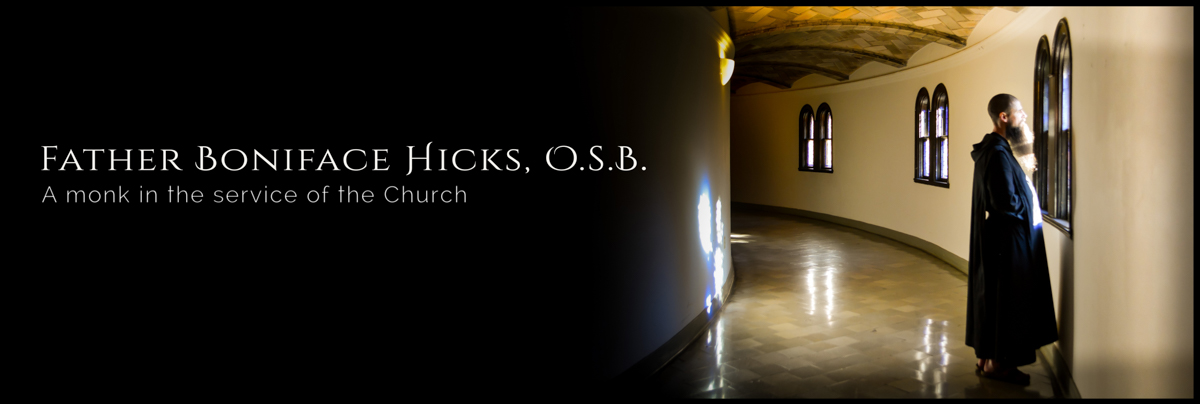
by Fr Boniface hicks OSB
Jesus cried out in a loud voice, ‘Lazarus, come out!’ The dead man came out ( John 11:43b-44a )
What was Lazarus’s experience? Why do we not hear a report about it? We are fascinated with “near-death” experiences (e.g. the recent book “Heaven is for Real” remained on the best seller list for over three years) and we have this feeling that if someone could scout ahead beyond the veil of death and come back to tell us about it, we would more easily believe (and more readily behave!). It is reminiscent of Israel’s explorations of the land beyond the Jordan river, the Promised Land–we would like to send a Caleb or Joshua ahead of us to reconnoiter the land and come back to tell us what it is like. But Jesus assures us, “If they will not listen to Moses and the prophets, neither will they be persuaded if someone should rise from the dead.” (Luke 16:31b)
Perhaps this is why Scripture tells us practically nothing about Lazarus’s experience of rising from the dead. It leaves us wondering, “What was it like?” It would be so interesting to know what his experience was…or would it? Perhaps we do not get more about Lazarus’s experience of waking up and emerging from the tomb because it is simply a distraction. As Jesus reported in the parable of Lazarus (a different Lazarus) and the rich man, “They have Moses and the prophets. Let them listen to them.” (Luke 16:29) Indeed, the law and the prophets, the Gospels and the epistles bring us closer to understanding the meaning of life (and eternal life) than someone who comes back from the dead (like Lazarus). How can this be?
Resurrection is more than a resuscitated corpse
Pope John Paul II explained this in the following way, “Eternal life should be understood in an eschatalogical sense, that is, as the full and perfect experience of the grace (charis) of God…” (TOB 67:5). Pope John Paul II clarified (in the same audience) that we already get a taste of this through faith, that this is an experience, “in which man can share through faith during his earthly life…” At the same time, we do not experience it fully, it will “only be revealed to those who will participate in the ‘other world’ in all its penetrating depth, [and] will also be experienced in its beatifying reality.” (TOB 67:5)
In order to participate “in all its penetrating depth” and experience this grace “in its beatifying reality,” we must be transformed in a way that is not only “by degree” but in a way that is “essential.” At the same time, we must be quick to clarify that this transformation does not involve any “disincarnation” or “dehumanization.” (TOB 67:2) Rather, there is a certain continuum between the human experience of this life, particularly the way that we are permeated by truth and love, and the divinized experience of the “other world.” (TOB 67:4) At the same time, our divinization in the “other world” is “incomparably superior to what can be reached in earthly life” (TOB 67:3).
“And behold, the curtain of the temple was torn in two, from top to bottom; and the earth shook, and the rocks were split; the tombs also were opened, and many bodies of the saints who had fallen asleep were raised, and coming out of the tombs after his resurrection they went into the holy city and appeared to many. When the centurion and those who were with him, keeping watch over Jesus, saw the earthquake and what took place, they were filled with awe, and said, “Truly this was the Son of God!” ( Matthew 27:51-54 )
These events are difficult for anyone to fully understand. The great Church writers have some possible explanations for this. One explanation is that the dead at the time of Jesus death rose like Lazarus and later on died a natural death. St Augustine and St Thomas lean toward this explanation because they feel it fits with sacred scripture .
An angel of the Lord descended from heaven and came and rolled back the stone, and sat upon it. His appearance was like lightning, and his raiment white as snow .. the angel said to the women, “Do not be afraid; for I know that you seek Jesus who was crucified. He is not here; for he has risen, as he said. Come, see the place where he lay. Then go quickly and tell his disciples that he has risen from the dead, and behold, he is going before you to Galilee; there you will see him. Lo, I have told you.” So they departed quickly from the tomb with fear and great joy, and ran to tell his disciples