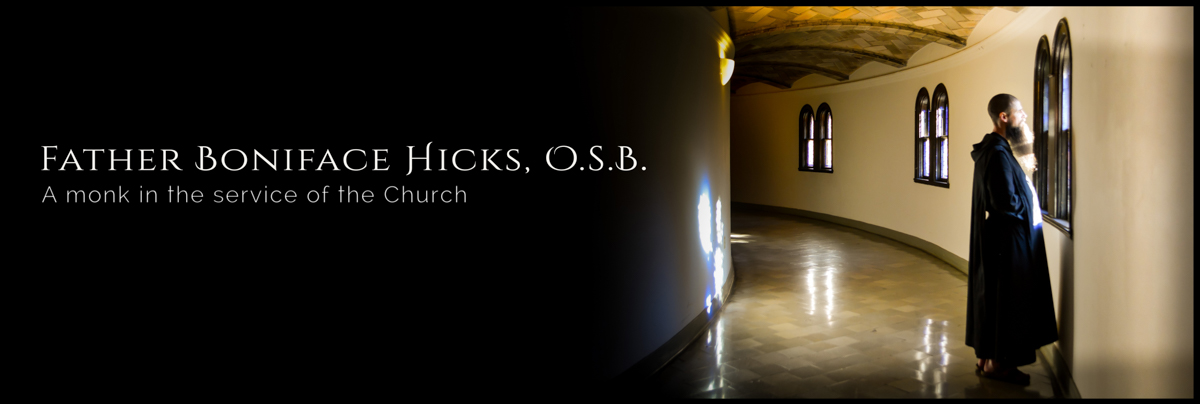
from the Shadows into the LIGHT


St. Gregory the Great was born during the lifetime of St. Benedict. He wrote the first account of St. Benedict. He tells us that the saint predicted his death. He had his tomb made a few days before he died and when his end came, he had himself taken to church and received communion. There he died, standing, his arms outstretched. In his death Saint Benedict conformed himself to the death of Christ, arms outstretched on the cross, as his hope was to rise with Christ to eternal life.
St. Gregory the Great wrote: “he gave orders for his tomb to be opened. Almost immediately, he was seized with a violent fever that rapidly wasted his remaining energy. Each day his condition grew worse until finally, on the sixth day, he had his disciples carry him into the chapel where he received the Body and Blood of our Lord to gain strength for his approaching end. Then, supporting his weakened body on the arms of his brethren, he stood with his hands raised to heaven and, as he prayed, breathed his last.” ( St. Gregory the Great, Book Two of Dialogues )
.


One hundred years ago, Pope Leo XIII had already exhorted the Catholic world to pray for the protection of St. Joseph, Patron of the whole Church. The Encyclical Epistle Quamquam Pluries appealed to Joseph’s “fatherly love…for the child Jesus” and commended to him, as “the provident guardian of the divine Family,” “the beloved inheritance which Jesus Christ purchased by his blood.” Since that time–as I recalled at the beginning of this Exhortation–the Church has implored the protection of St. Joseph on the basis of “that sacred bond of charity which united him to the Immaculate Virgin Mother of God,” and the Church has commended to Joseph all of her cares, including those dangers which threaten the human family.
Even today we have many reasons to pray in a similar way: “Most beloved father, dispel the evil of falsehood and sin…graciously assist us from heaven in our struggle with the powers of darkness…and just as once you saved the Child Jesus from mortal danger, so now defend God’s holy Church from the snares of her enemies and from all adversity.” Today we still have good reason to commend everyone to St. Joseph.
– Pope St John Paul II

.


There are three things by which faith stands firm, devotion remains constant, and virtue endures. They are prayer, fasting and mercy. Prayer knocks at the door, fasting obtains, mercy receives. Prayer, mercy and fasting: these three are one, and they give life to each other.
Fasting is the soul of prayer, mercy is the lifeblood of fasting. Let no one try to separate them; they cannot be separated. If you have only one of them or not all together, you have nothing. So if you pray, fast; if you fast, show mercy; if you want your petition to be heard, hear the petition of others. If you do not close your ear to others you open God’s ear to yourself.
When you fast, see the fasting of others. If you want God to know that you are hungry, know that another is hungry. If you hope for mercy, show mercy. If you look for kindness, show kindness. If you want to receive, give. If you ask for yourself what you deny to others, your asking is a mockery.
Let this be the pattern for all men when they practise mercy: show mercy to others in the same way, with the same generosity, with the same promptness, as you want others to show mercy to you.
Therefore, let prayer, mercy and fasting be one single plea to God on our behalf, one speech in our defence, a threefold united prayer in our favour.
Let us use fasting to make up for what we have lost by despising others. Let us offer our souls in sacrifice by means of fasting. There is nothing more pleasing that we can offer to God, as the psalmist said in prophecy: A sacrifice to God is a broken spirit; God does not despise a bruised and humbled heart.
Offer your soul to God, make him an oblation of your fasting, so that your soul may be a pure offering, a holy sacrifice, a living victim, remaining your own and at the same time made over to God. Whoever fails to give this to God will not be excused, for if you are to give him yourself you are never without the means of giving.
To make these acceptable, mercy must be added. Fasting bears no fruit unless it is watered by mercy. Fasting dries up when mercy dries up. Mercy is to fasting as rain is to earth. However much you may cultivate your heart, clear the soil of your nature, root out vices, sow virtues, if you do not release the springs of mercy, your fasting will bear no fruit.
When you fast, if your mercy is thin your harvest will be thin; when you fast, what you pour out in mercy overflows into your barn. Therefore, do not lose by saving, but gather in by scattering. Give to the poor, and you give to yourself.
.
