Category Archives: Spiritual Practices

Spiritual Practices

St Peter and St Paul

From a sermon by Saint Augustine

This day has been consecrated for us by the martyrdom of the blessed apostles Peter and Paul. It is not some obscure martyrs we are talking about. Their sound has gone out into all the earth, and their words to the ends of the world. These martyrs had seen what they proclaimed, they pursued justice by confessing the truth, by dying for the truth.

Before his passion the Lord Jesus, as you know, chose those disciples of his whom he called apostles. Among these it was only Peter who almost everywhere was given the privilege of representing the whole Church. It was in the person of the whole Church, which he alone represented, that he was privileged to hear, To you will I give the keys of the kingdom of heaven. After all, it is not just one man that received these keys, but the Church in its unity. So this is the reason for Peter’s acknowledged pre-eminence, that he stood for the Church’s universality and unity, when he was told, To you I am entrusting, what has in fact been entrusted to all. To show you that it is the Church which has received the keys of the kingdom of heaven, listen to what the Lord says in another place to all his apostles: Receive the Holy Spirit; and immediately afterwards, Whose sins you forgive, they will be forgiven them; whose sins you retain, they will be retained.

There is one day for the passion of two apostles. But these two also were as one; although they suffered on different days, they were as one. Peter went first, Paul followed. We are celebrating a feast day, consecrated for us by the blood of the apostles. Let us love their faith, their lives, their labours, their sufferings, their confession of faith, their preaching.

Immaculate Heart of Mary . Saturday

“Mary, give me your Heart: so beautiful, so pure, so immaculate; your Heart so full of love and humility that I may be able to receive Jesus in the Bread of Life and love Him as you love Him and serve Him in the distressing guise of the poor.” – Saint Teresa of Calcutta

“Be Not Afraid; my Immaculate Heart will be your refuge and your safe passage to God.”
– Our Lady of Fatima

“Sacrifice yourselves for sinners and say many times, especially when you make some sacrifice: ‘O Jesus, it is for Thy love, for the conversion of sinners and in reparation for sins committed against the Immaculate Heart of Mary.” – Our Lady of Fatima

“If you put all the love of the mothers into one heart it still would not equal the love of the Heart of Mary for her children.” – Saint Louis de Montfort

Corpus Christi Sunday

Treatise on the Our Father

We ask “Give us this day our daily bread

We ask that this bread should be given to us daily, that we who are in Christ and daily receive the Eucharist as the food of salvation may not be prevented, by the interposition of some heinous sin, from partaking of the heavenly bread and be separated from Christ’s body, for as he says: I am the bread of life which came down from heaven. If anyone eats of my bread, he will live for ever; and the bread I shall give is my flesh, for the life of the world.

So when he says that whoever eats of his bread will live for ever; and as it is clear that those are indeed living who partake of his body and, having the right of communion, receive the Eucharist, so, on the other hand, we must fear and pray lest anyone should be kept at a distance from salvation who, being withheld from communion, remains separate from Christ’s body.

For he has given us this warning: Unless you eat the flesh of the Son of man and drink his blood, you will have no life in you. And therefore we ask that our bread – that is, Christ – may be given to us daily, so that we who live in Christ may not depart from his sanctification and his body.

After this we entreat for our sins, saying Forgive us our debts, as we forgive our debtors.
After the supply of food, pardon of sin is also asked for.

How necessary, how provident, how salutary are we reminded that we are sinners, since we have to beg for forgiveness, and while we ask for God’s pardon, we are reminded of our own consciousness of guilt! Just in case anyone should think himself innocent and, by thus exalting himself, should more utterly perish, he is taught and instructed that he sins every day, since he is commanded to pray daily for forgiveness.

St Cyprian . Bishop and Martyr

Happy Father’s Day

Reflections on Father’s Day
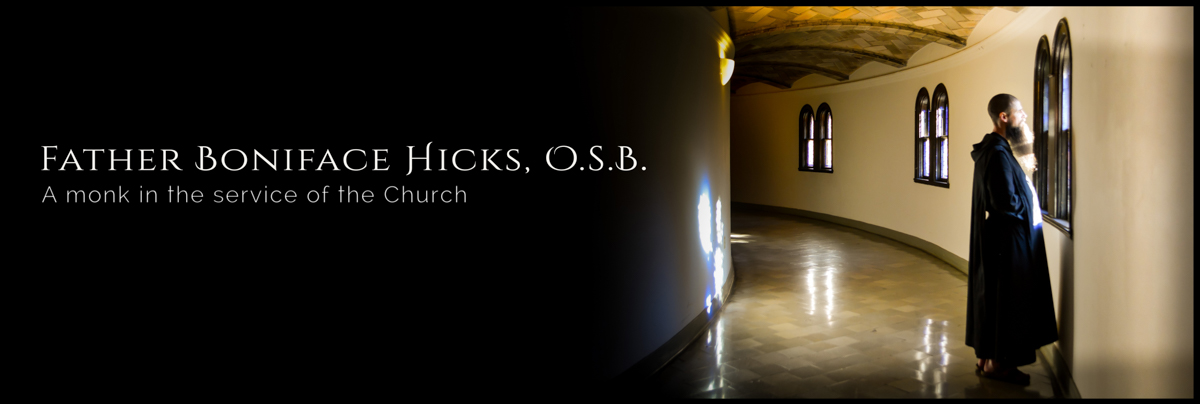
by Fr Boniface Hicks OSB

Rod Dreher proposed “The Benedict Option” as a way to move forward in our challenging times. He described how the Rule of Saint Benedict provides the culture-changing wisdom that could create a leaven to transform our world from the ground up. In my own reflections, it seems to me that Saint Benedict actually promotes “The Joseph Option.” His wisdom for monasteries helps them to become another Nazareth where we live the lives of Mary and Joseph always in the presence of Jesus. In Nazareth, the Gospel principles were lived out in such an unremarkable way that the locals were shocked when Jesus declared himself to be the Messiah (cf. Luke 4). And yet the Gospel principles were lived out in such a powerful way that God himself was always fully present, and it became the starting place of a new creation.

We can see the connections of Benedict and Nazareth in several ways. A Benedictine monastery is founded on the vow of stability so that the collective holiness from living out God’s will steadily permeates the place and it becomes an oasis of peace for visitors. I like to imagine that Nazareth was quite a peaceful place to visit and that the Holy Family was a wonderful model of hospitality in the decades they dwelt there. In a Benedictine monastery, the keynote is found in chapter 19 of the Rule: “We believe that the divine presence is everywhere . . .” and the orientation of everything in the monastery fosters greater awareness of that fact. In Nazareth, Mary and Joseph helped each other remember that their little boy was the Incarnate Word of God and they did everything in the divine presence. Saint Benedict described the monastery as a “school for the Lord’s service” (RB Prologue 45) and Pope Saint Paul VI described Nazareth as “the school in which we begin to understand the life of Jesus. It is the school of the Gospel” (Homily 5 January 1964 in Nazareth).

At Saint Vincent, we have another Nazareth where countless people have come in the last 175 years to enter into the divine presence. In the peace that comes from the first moments on the grounds to encounters with the various residents and finding a high point in the Basilica and the liturgy, hearts are changed, love grows, the Gospel is internalized and our world is improved a little bit at a time. It is providential that the Year of Saint Joseph coincides with our 175th anniversary. As we approach Father’s Day let us invoke our fathers Saint Joseph and Saint Benedict to help us foster another Nazareth and bring Jesus more tangibly into our world, so that “in all things God may be glorified!” (Rule 57:9; based on 1 Peter 4:11).

Image by Portraits of Saints . Website

Solemnity of Corpus Christi . This Sunday

The culmination of the Mass is not the consecration, but Communion
God dwells in our midst, in the Blessed Sacrament of the altar.
– St. Maximilian Kolbe

When you have received Him, stir up your heart to do Him homage; speak to Him about your spiritual life, gazing upon Him in your soul where He is present for your happiness; welcome Him as warmly as possible, and behave outwardly in such a way that your actions may give proof to all of His Presence.
– St. Francis de Sales

O Lord, we cannot go to the pool of Siloe to which you sent the blind man. But we have the chalice of Your Precious Blood, filled with life and light. The purer we are, the more we receive.
– St. Ephraem

If angels could be jealous of men, they would be so for one reason: Holy Communion.
– St. Maximilian Kolbe