When Mary Magdalene came to the tomb and did not find the Lord’s body, she thought it had been taken away and so informed the disciples. After they came and saw the tomb, they too believed what Mary had told them. The text then says: The disciples went back home, and it adds: but Mary wept and remained standing outside the tomb.
We should reflect on Mary’s attitude and the great love she felt for Christ; for though the disciples had left the tomb, she remained. She was still seeking the one she had not found, and while she sought she wept; burning with the fire of love, she longed for him who she thought had been taken away. And so it happened that the woman who stayed behind to seek Christ was the only one to see him. For perseverance is essential to any good deed, as the voice of truth tells us: Whoever perseveres to the end will be saved.
When our desires are not satisfied, they grow stronger, and becoming stronger they take hold of their object. Holy desires likewise grow with anticipation. As David says: My soul has thirsted for the living God; when shall I come and appear before the face of God?
Woman, why are you weeping? Whom do you seek? She is asked why she is sorrowing so that her desire might be strengthened; for when she mentions whom she is seeking, her love is kindled all the more ardently.
from a homily Gregory the Great
.
All things have an end, and two things, life and death, are side by side set before us, and each one will go to his own place. Just as there are two coinages, one of God and the other of the world, each with its own image, so unbelievers bear the image of this world, and those who have faith with love bear the image of God the Father through Jesus Christ our Lord.
St Ignatius of Antioch
.
God and Father,
To those who go astray you reveal the light of your truth and enable them to return to the right path. Grant that all who have received the light of grace may strive to do good and avoid evil
Be gracious, to us Lord who love and serve you and in your kindness increase your gifts of grace within us: so that, fervent in faith, hope and love, we may be ever on the watch and persevere in doing what you command.
Like a deer that longs for springs of water, so my soul longs for you, O God. Now just as those deer long for springs of water, so do our deer. Fleeing Egypt – that is, fleeing worldly things – they have killed Pharaoh and drowned all his army in the waters of baptism. Now, after the devil has been killed, they long for the springs of the Church: the Father, the Son, and the Holy Spirit.
Welcomed into the body of Christ and reborn in the springs of life, they confidently say: I will go up to your glorious dwelling-place and into the house of God. The house of God is the Church, the ‘dwelling-place’ where dwells the sound of joy and thanksgiving, the crowds at the festival.
So then, you who have followed our lead and robed yourselves in Christ, let the words of God lift you out of this turbulent age as a net lifts the little fishes out of the water. In us the laws of nature are turned upside down – for fish, taken out of the water, die; but the Apostles have fished us out of the sea that is this world not to kill us but to bring us from death to life. As long as we were in the world, our eyes were peering into the depths and we led our lives in the mud. Now we have been torn from the waves, we begin to see the true light. Moved by overwhelming joy, we say to our souls: Put your hope in the Lord, I will praise him still, my saviour and my God.
.
From a sermon by Saint Augustine
This is our glory: the witness of our conscience. There are men who rashly judge, who slander, whisper and murmur, who are eager to suspect what they do not see, and eager to spread abroad things they have not even a suspicion of. Against men of this sort, what defence is there save the witness of our own conscience?
Beloved, we do not seek, nor should we seek, our own glory even among those whose approval we desire. What we should seek is their salvation, so that if we walk as we should they will not go astray in following us. They should imitate us if we are imitators of Christ; and if we are not, they should still imitate him. He cares for his flock, and he alone is to be found with those who care for their flocks, because they are all in him.
You have listened to our Lord Jesus Christ as he taught his apostles: Let your actions shine before men so that they may see your good deeds, and give glory to your Father who is in heaven, for it is the Father who made you thus. We are the people of his pasture, the sheep of his hands. If then you are good, praise is due to him who made you so.
.
St Teresa of Ávila – Thy Kingdom Come
Eternal Wisdom ! Between you and your Father this was quite sufficient. This is how you made your request of him in the garden of Gethsemane. You showed him what you wished for and what you feared, but left it all in his hands. But you know us, my Lord, and you know that we have not given ourselves up to the will of your Father as completely as you did. For us, it is best to pray for specific things, so that as each of them comes to mind we can pause to consider whether it is something good that we are asking for; so that if it is not, we should refrain from asking for it. Otherwise ( being what we are, free will and all ) we will not accept what God chooses to give us even if it is far better than what we asked for, simply because it is not exactly what we asked for. We are the sort of people who cannot feel rich unless we feel the weight of the actual coins in our hand.
Now the good Jesus bids us say these words, in which we pray that the Kingdom may come in us: Hallowed be thy name, thy Kingdom come. See how great our Master’s wisdom is!
Now, then. The greatest joy in the kingdom of heaven (the greatest among many) seems to me to be that we will no longer be tied up with earthly concerns but will have rest and glory within us – rejoicing that gives joy to everyone, peace that lasts for ever – satisfaction in ourselves, a satisfaction that comes from seeing how everyone is praising the Lord and blessing and hallowing his name, while no-one offends him. Everyone loves him. Each soul has no wish other than to love him: it cannot stop loving him because it knows him truly.If only we knew him like that even here on earth, we would love him in the same way.
.
The Explanation of Psalm 118 by Saint Ambrose
Blessed is he, therefore, at whose door Christ comes knocking. Faith is the door of the soul, and if it is strong then it fortifies the whole house. Through this door Christ enters.
You see that when the Word of God knocks hardest on your door, it is when his hair is wet with the dew of the night. In fact he chooses to visit those who are in tribulation and trial, lest one of them be overwhelmed by distress. So his head is covered with dew, with drops, when his body is labouring hard. It is important to keep watch so that when the Bridegroom comes, he is not shut out. If you are asleep and your heart is not keeping watch, he will go away without knocking; but if your heart is alert for his coming, he knocks and asks for the door to be opened to him.
Thus you see that our soul has a door, but we have gates too, as the psalm says: Gates, raise your heads. Stand up, eternal doors, and let the king of glory enter. If you choose to raise your gates, the King of glory will come to you, celebrating the triumph of his own Passion. For righteousness has gates, as we see it written when the Lord Jesus speaks through his prophets: Open to me the gates of righteousness.
It is the soul that has its door, it is the soul that has its gates. To that door Christ comes and knocks, he knocks at the door. Open to him, therefore: he wishes to come in, the Bridegroom wishes to find you keeping watch.
Prayer is the best weapon we have; it is the key to God’s heart. You must speak to Jesus not only with your lips, but with your heart. In fact on certain occasions you should only speak to Him with your heart.
– Padre Pio
This Beloved of ours is merciful and good. Besides, he so deeply longs for our love that he keeps calling us to come closer … For now, his voice reaches us through words spoken by good people, through listening to spiritual talks, and reading sacred literature. God calls to us in countless little ways all the time. Through illnesses and suffering and through sorrow he calls to us. Through a truth glimpsed fleetingly in a state of prayer he calls to us. No matter how halfhearted such insights may be, God rejoices whenever we learn what he is trying to teach us.
– St Teresa of Avila
Prayer is not asking. Prayer is putting oneself in the hands of God, at His disposition, and listening to His voice in the depth of our hearts … I do not pray for success, I ask for faithfulness.
– Mother Teresa
The closer one approaches to God, the simpler one becomes … For prayer is nothing else than being on terms of friendship with God.
Pange, lingua, gloriósi Córporis mystérium, Sanguinísque pretiósi, Quem in mundi prétium Fructus ventris generósi Rex effúdit géntium.
Nobis datus, nobis natus Ex intácta Vírgine, Et in mundo conversátus, Sparso verbi sémine, Sui moras incolátus Miro clausit órdine.
Sing, my tongue, the Saviour’s glory, Of His Flesh, the mystery sing; Of the Blood, all price exceeding, Shed by our Immortal King, Destined, for the world’s redemption, From a noble Womb to spring.
Of a pure and spotless Virgin Born for us on earth below, He, as Man, with man conversing, Stayed, the seeds of truth to sow; Then He closed in solemn order Wondrously His Life of woe.
From Conversion to Vocation My Calling to be a Benedictine
A Monk ??
My first visit to Saint Vincent Archabbey, the Benedictine monastery that is now my home, was an experience of transformation and growing trust in God. Led by our campus minister I arrived with some other college students on a Friday evening and enjoyed some pizza with the group in the novitiate lounge of the monastery. I had no idea what a monastery was aside from movies and fiction novels. I had no interest in being a part of the stereotype of monastic life I had in my head from movies like Monty Python’s “The Quest for the Holy Grail.” I felt a particular call to share the gift of prayer I had received during my studies in Germany, which I had rephrased in my mind as “evangelization,” and I did not imagine that that was part of the life of a monk. So I had rather low expectations of my first visit to Saint Vincent Archabbey, but I was open and willing to learn.
After a pleasant, social time on arrival, I slept quickly and got up early to join some monks for a time of Eucharistic adoration at 5:30am in a small chapel and then later followed the monks to morning prayer and Mass with the whole monastic community in the Archabbey’s beautiful Basilica. Then after some pleasant encounters with some monks throughout the day, followed by chanted Vespers and dinner, I retired to my guest room in the monastery. I had some time before the evening recreation and so I picked up the small Rule of Saint Benedict that was in my room. Looking at the table of contents my eyes were drawn to the chapter on humility, because it was a Christian virtue I had recently become interested in. Reading the chapter on humility, however, immediately summoned up in my mind all the scary stereotypes of a harsh, inhumane, medieval monasticism that belonged more to the “Dark Ages” than to our “enlightened” modern times. (Side note: I love those passages on humility now that I have learned the deeper meaning and context in which Saint Benedict teaches us!) Suddenly the reality that I was in a monastery came crashing down on me and I wondered what had happened to my life to bring me to this point! I was aghast and started plotting my escape, not wanting to spend another night in such a place. At least I planned to hide in my bed and sleep through everything until our departure the next day.
Catching myself, I took a deep breath and said a prayer: “Jesus, I need your help! I am going to make an act of faith and go to recreation, but you need to give me something to hold on to!” Jesus is faithful. I went to recreation and discovered a cribbage game with three players awaiting a fourth. I sat down across from one of the players who was wearing a t-shirt with the words, “Ich spreche, ich lehre, ich liebe Deutsch,” and when I read it out loud, that monk lit up and engaged me in German for a few sentences. When everyone departed after our cribbage game, I stayed for almost three hours speaking to this monk and sharing with him all the events that had led me to baptism, to discern a vocation and ultimately to Saint Vincent Archabbey. In the course of sharing my journey with him, the grace returned and I was flooded with a spiritual consolation as I saw how actively God had been guiding my life. It broke through my fears and renewed my strength to stay the rest of the weekend. I left Saint Vincent the next day with such a love for the place and the monks that I declared to my spiritual director that I would love to join right away.
God directed my decision
I knew I could not join right away because I had only been baptized for a week! More important for me was the fact that I could not say I ever heard God calling me to priesthood or religious life. I knew my desire for priesthood was strong and I believed my insight to share the gift of prayer (which I had reformulated as “evangelization”) was inspired but I could not say I had heard, in a time of spiritual consolation, God confirming my call.
That confirmation came at World Youth Day in Paris. During our trip to Paris, our group spent time at the parish of Le Trinite where I had the opportunity for an extended time of Eucharistic adoration. As I knelt in the silence and read the Gospel account about the call of the first Apostles, I was inspired to ask Jesus what He wanted from me. I said to Him in my heart, “I want to do whatever you want me to do. Do you want me to become a priest?” As everything became perfectly silent inside of me in great stillness and peace, I believed I heard Him say “Yes.” That filled me with a great joy that stayed with me the rest of the day and the intensity and concreteness of the memory lingered long after that.
At the same time, it was still on my mind that my call was to “evangelization,” and so I had started to abstractly exclude the possibility of a Benedictine vocation despite the powerful first visit I had had to Saint Vincent. I did not understand how Benedictines evangelize (I can write several books on that now!). I still returned for another visit however and on that visit, one of the monks told me about a Franciscan community that was trying to live the charism of Saint Francis more radically and they were devoted to evangelization. That led me to visit the Franciscan Friars of the Renewal (the “CFRs”) in New York City. I spent a week with them and loved my visit. I loved the friars, I loved their radical zeal for the Gospel, I loved their courageous ministry to the poor and their fearless proclamation of the Gospel. I learned many things from them about how to live the faith. They helped me formulate some ideals that have stayed with me for over two decades now. To my surprise, however, that was not God’s plan for my life.
In what I planned as a final act of discernment, I divided up my spring break into several days with the CFRs followed by several days with the Benedictines at Saint Vincent Archabbey. In my days with the CFRs while I watched the postulants receive their habits as they became novices, I tried to picture myself in their gray habits. Despite my best efforts, I kept seeing myself in a black habit instead. Then as I participated in the Mass when the novices made their first vows, I tried to imagine myself kneeling there and making vows with the friars, but I kept seeing myself in the Basilica at Saint Vincent instead. Slowly an inner tension had formed during my visit to the CFRs.
In the discomfort of this inner tension, I was moved to make an act of surrender and I told the Lord that I wanted to do whatever He wanted me to do: “If you want me to go to Saint Vincent, I will go to Saint Vincent.” At that moment I was flooded with peace and all the tension was resolved. That communicated a clear message to me in spite of my preference to become a CFR at that point. But the spiritual consolation in that prayer of surrender moved me deeply and my mind quickly embraced the idea of becoming a Benedict at Saint Vincent Archabbey. A last vestige of my stubborn self-will pondered asking for the name “Francis”, but my surrender was complete when I opened to a Benedictine name and quickly remembered the name, “Boniface.” I had learned about St. Boniface during my time in Germany and remembered that he was a missionary Benedictine monk and the Apostle to Germany.
Following my visit to the CFRs I spent a few days at Saint Vincent and told the Abbot about my desire to enter the monastery. He was surprised, because I was still so newly baptized (I was Catholic for only one year at that point) and he wisely put a damper on my zeal saying that he would discuss it with the Council of Seniors. Even at that, I was not discouraged. In fact, it was a further confirmation for me because I discovered in that experience that I actually had total trust in whatever the Abbot, under consultation with the community, would discern was God’s will for me. There was a grace of obedience at work in my heart in that experience and I was already anticipating the way that God would work in my life through my Abbot. In the end, the community decided to accept me, as an exception to the general rule, only 15 months after Baptism. I entered the monastery on July 1, 1998 and I received the habit and the name Boniface a few days later.
Why a Benedictine?
In this article, I set out to explain my personal call to the Benedictine life. I have described the steps to becoming Catholic and discerning my call to Saint Vincent Archabbey, but I have revealed little about the Benedictine charism or why I believe that this is the charism I was called to embody and live out for the rest of my life. Although it sounds trite, I can say that I became a Benedictine at Saint Vincent Archabbey because I believe God called me to that. I did not become a Benedictine because we have a college or a seminary or a large community or regular liturgical prayer or a beautiful Basilica. I had some organic, human connections that brought me to the community and I believe that in prayer God called me to join that community and give my life to Him there.
As a novice I could not have described in detail what drew me to the Benedictine community at Saint Vincent Archabbey, other than prayer and the grace of God. After twenty years in the community, however, I can now see more clearly why God called me here. The initial desire that rose up in my heart is indeed the one that was able to unfold at Saint Vincent in the most beautiful way, namely “to share the gift of prayer.” Although I had translated that into “evangelization” and I have found many opportunities to evangelize, ultimately my desire was always to share the gift of prayer. I believe that was also God’s desire for me and that is why He brought me to Saint Vincent Archabbey. As a Benedictine monk in a very large and active monastery I have had abundant opportunities to learn prayer and share prayer, especially through teaching and spiritual direction.
The Benedictine life is oriented towards learning to pray. St. Benedict gives the main criterion for monastic life: “The concern must be whether the novice truly seeks God…” (RB 58:7) Fundamentally, to learn to pray is to truly seek God. The monk develops a living, personal relationship with our God who is Himself personal, in fact tri-Personal. That relationship, which is the basis for everything else, stretches across time into every moment of the monk’s life. This constant loving awareness of the presence of God could be seen as the principal theme of the Rule of Saint Benedict: “We believe that the divine presence is everywhere…” (RB 19:1). The rest of the rule arranges the life of the monk to become more responsive to God’s presence in everything he does.
In other words, the monk learns how to do everything in relationship with God. He learns how to turn his life into constant prayer. That begins with concrete prayer times as Saint Benedict makes clear in the next verse of the Rule, “But beyond the least doubt we should believe this to be especially true when we celebrate the divine office” (RB 19:2). The divine office (the liturgy of the hours) is the heartbeat of every monastery. Additionally, Saint Benedict prescribed long periods of time (up to four hours a day, as it is still practiced in more contemplative monasteries) to the practice of prayerful reading called “lectio divina.” The liturgy, lectio divina and the monastic culture of scheduled activities bracketed by prayer are the primary means for growing in prayer.
Additionally, there is a special apostolic emphasis on hospitality. This comes from the unique Benedictine vow of stability. Stability leads to the sanctification of a place and the inevitable draw for guests to experience that holy place and its praying monastic community. Saint Benedict comments in the Rule that monasteries are never without guests (RB 53:16). Furthermore, the guests at monasteries are generally those who want to share in the grace of the monastery and so we call them retreatants. The natural ministry to retreatants is teaching them to pray as a group through retreat conferences and individually through spiritual direction.
For these reasons, teaching prayer became part and parcel of my life at Saint Vincent Archabbey. As my monastic life developed, this ministry extended beyond the walls of Saint Vincent, and I began to offer retreats and spiritual direction in more diverse places and for a wide variety of people. The most recent development in my monastic journey has been to write books on spiritual direction and personal prayer and to offer spiritual direction formation for a wide range of people through our Seminary’s Institute for Ministry Formation.
I did not understand everything that God was calling me to when He drew me, through prayer, to the Benedictine monastery of Saint Vincent Archabbey, but what I have discovered and lived out has been more fulfilling than I ever dreamed possible. I am deeply grateful for my Benedictine vocation.
From Conversion to Vocation My Calling to be a Benedictine
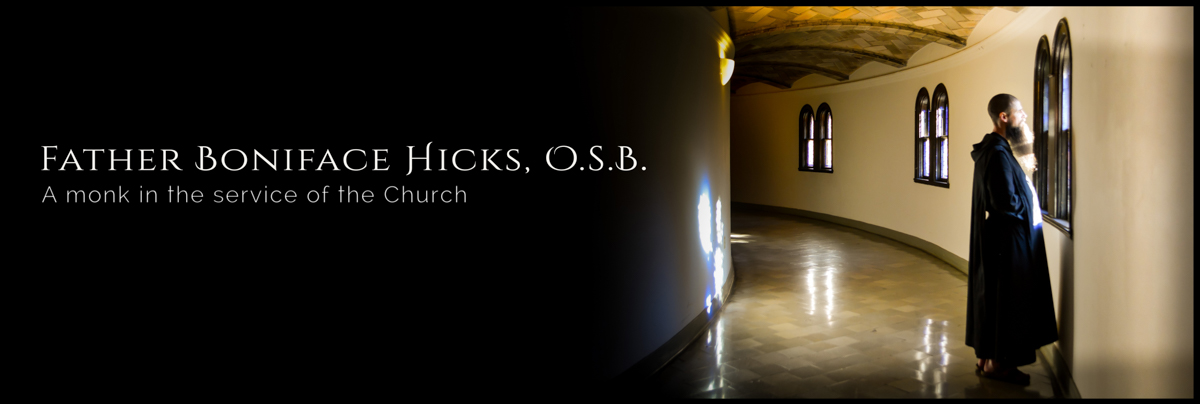
By Fr. Boniface Hicks OSB
A principal theme in my own faith journey is that God writes straight with crooked lines. A more eloquent way to say it would be that every calling is as unique as each individual. Another important interpretive tool is knowing that life is lived forward and understood backward. With these points in mind, I can say that I believe whole-heartedly that my life as a Benedictine monk is exactly where God wants me to be. At the same time, I can say that the more I live out this vocation the more I understand why this is where He wants me.
I was raised in a very loving and moral home, but without any religious practice. The influences of society and public education steadily led me to a scientific atheist mindset that was fortunately not well fortified. It was slowly whittled down by the witness of friends in college who were in the honors program and scientific disciplines but also attended Mass regularly. Then the real journey began for me when an evangelical man came up to me on my college campus and invited me to study the Bible with him one on one. He was a total stranger to me and, to be honest I was quite disinterested and dismissive of him in my thoughts, but when he finally asked me, after a lengthy introduction, whether I would meet with him for a Bible study, I agreed. He was a real believer and the humble, authentic witness of his relationship with God delivered the Truth through my defenses. After nine months of meetings we covered the book of Genesis through the story of Abraham before moving to the Gospel of John. After I read the Prologue of John I became a Christian. I believed that God was real and the Bible was true and I started going to Mass on Sundays.
Six months later I went to Germany for a study abroad. By that time I was meeting daily for Bible study and my life was slowly transformed as I took in the Word of God and that Word brought deeper peace to my heart. Our daily Bible study was structured like a shared lectio divina with a short reading from a passage, time for personal reflection, which we wrote down and then read to each other, and then a time of spontaneous, vocal prayer. I was receiving a lot from the Word and from these wholesome, upbuilding times of shared prayer. There was still some resistance in me, however, that emerged and I planned my trip to Germany. I thought of taking a break from all the Christian stuff I was doing, growing my hair out again, and taking advantage of the lower legal age for alcohol consumption. The man I was studying the Bible with was praying for me, however, and with some divine inspiration he said to me one morning that he wanted to send me to Germany as a missionary. I was concerned and a little afraid of that idea, but I surrendered, trusted and prayed about it. My experience in Germany was life-changing and set the stage for my vocation.
I still had some resistance when I got on the plane and formulated the thought that if God wanted me to be a missionary He could let me know. When I landed on a Saturday morning, I was met by some evangelicals from the same Bible study movement as I had been part of. I understood that they were going to take me to the train so I could continue on my way to the University in Marburg. Instead they took me to their home, fed me and visited with me. When I finally intervened and asked about getting to the train, they decided to call the University first to make sure someone would be there to meet me, but no one answered. They urged me to stay with them for the weekend lest I be stuck in a hotel in Marburg. After reluctantly agreeing, they asked if I would be willing to give my life testimony at their worship service the next day. Again I agreed reluctantly and so my second day in Germany I gave witness to God’s work in my life, in German, at a worship service. After the initial shock wore off from the unexpected change in plans, I had a beautiful weekend. God had averted my plans to drift from my Christian faith.
The real breakthrough came a few weeks later, however. After an initial language course that was easy for me, I began taking German graduate-level classes in Math and Computer Science. I was overwhelmed by school for the first time in my life. For the first time in my life I turned to God out of my weakness. I prayed for help. He intervened in miraculous ways and provided for my needs. In the wake of that, something happened one morning during my prayer time. I suddenly felt that He was close to me. A felt peace and a presence and the rest of the world became very distant. I realized that I could talk to Him and also listen for Him in my heart. The thoughts that came to me had a strangely different quality as they emerged from an interior quiet that was tangibly different from my normal experience. I felt profound love and reassurance. I was also challenged as I asked Him if there was anything in my life I needed to change. Even then, however, I knew I could tell Him that I wouldn’t be able to change that on my own and I would need His help. After that experience, I started turning to God for the smallest things—from asking which way to walk to class that day to asking which meat I should buy for dinner.
Immediately after this initial encounter with God in prayer, I realized how amazing it was that I could have such a personal relationship with Him and I spontaneously thought that it would be worth dedicating my life to sharing this gift with others. That was the kernel of my vocation—the desire to share the gift of prayer.
The Growth of a Vocation
The kernel of my vocation was in my initial experience of a personal encounter with God in prayer. In retrospect I can apply the teaching of St. Ignatius of Loyola to that experience and say that it was my first experience of spiritual consolation. In the experience of inner quiet and the presence of God that lifted me above every created thing, I was able to hear truth in my heart that I trusted and followed. In the weeks that followed that initial experience, I explored the contours of my inner experience of God, trying to understand what was necessary to be sure it was God speaking to me through the veil of faith. When I finally discovered the teaching of St. Ignatius many years later, it perfectly described what I had been trying to grasp in those initial weeks of my experience of God in prayer while I was studying in Germany.
During that grace-filled time of my life, I developed a real desire to dedicate my life to sharing the gift of prayer. So early in my Christian journey, I did not have adequate categories or concepts to work with, however. After all, I was not even baptized yet. My initial thought was to become a priest, because I knew priests dedicated their lives to sharing prayer. To demonstrate how strong my conviction was, I was not deterred in the least by the sacrifices that would entail. That felt very secondary to me at that point.
When I returned from Germany, however, my prayer life diminished. Combined with some moral lapses and the busyness of my last year of college pushed my vocation farther from my mind. In retrospect when I look at that period in my life I feel the ache of the words of Jesus in the Book of Revelation, “But I have this against you, that you have abandoned the love you had at first. Remember then from what you have fallen, repent and do the works you did at first” (Rev 2:4-5). The good news is that I started RCIA at that time and began my formal journey into the Catholic Church. I had also continued with Bible study was becoming more involved in the evangelical group that promoted those one-on-one Bible studies.
Fortunately, various factors led to a renewal of my vocation. One of those factors was when the two paths I had been walking in parallel finally turned into a crossroads. My Christian journey had begun and developed through a Bible study with an evangelical group at Penn State. My religious practice had developed through attending Catholic Mass and preparing to receive the Sacraments of initiation. On the morning of Holy Thursday, after several attempts to help me see that I could not continue on these two paths in parallel indefinitely, the man I was studying the Bible with helped me to see that if I was planning to be baptized Catholic, I needed to commit myself to ministry in the Catholic Church. Otherwise I could continue with ministry in the Bible fellowship.
I did not want to break from either path. I was driven to my knees and spent the day in prayer. At one point, while I was praying before the Lord in the Tabernacle, I asked Him what I should do and I saw the flame of the sanctuary lamp flare up slightly. The words that came with it were, “I want you to fan the flame of my Church.” From that point, things fell into place as I started to discover that attending Mass for two years without receiving Communion had developed quite a hunger in me for the Sacraments. So, on Holy Thursday, two days before receiving the Sacraments of initiation, I made a decision in my heart to give my life to God for service in the Catholic Church, whatever that might look like.
The campus minister, who was a Benedictine priest from Saint Vincent Archabbey, invited me to join him and some other students on the weekend after Easter for a vocation retreat at the Archabbey. I had no idea what a monk was, but the stereotype in my mind made me dismiss the idea of a monastic vocation, because I felt so drawn to share faith with people, not just to hide away and pray. At the same time, I thought a weekend retreat would be fulfilling and I am always open to learn. In fact, it turned out to be a profound experience.
The Ear of the Heart – “attend to them with the ear of your heart”
Saint Benedict teaches the monk in the first verse that there is a deeper way of listening.We take in reality through our five external senses (sight, hearing, etc.) but we also learn to detect something deeper.Reality is not merely a scientfic fact.All of reality conveys meaning as well.When we look at a car we do not normally see a metal object made of thousands of parts.Rather we see transportation that moves us from point A to point B.When we look at a subway car or a subway line, it appears to us as a portal that picks us up at one place and drops us at another.When we see physical objects, their meaning presents themselves to us first.This is so strong, in fact, that we simply do not see things that are not meaningful to us.When we are driving on the highway, we block out most of the things around us and focus on a few things in front of us.When we are walking through city streets we simply never notice things that do not affect us or have any impact on our purpose.The direction of our intention (the focus of our inner eye or the attention of our inner ear) determines what we perceive.This is why it is so important to focus our attention appropriately, and Saint Benedict instructs us to focus the attention of the ear of heart on the Master’s instructions.
God speaks through everything.The Word is constantly expressing Itself through creation and through history.The Word can be heard in human events and through human voices.Every event carries a deeper meaning if we can tune our ears to hear it.
A Benedictine motto was developed in the 18th century to summarize the Benedictine life: ora et labora (pray and work).By focusing on prayer first, but then by balancing prayer and work, the monk learns to listen to God even during his work.Saint Benedict noted that the monk is to “regard all utensils and goods of the monastery as sacred vessels of the altar and nothing is to be neglected” (RB 31:10-11).This shows the potential that Saint Benedict sees for finding God in work.Work can be carried out with attention and reverence.The monk can listen to God with the ears of the heart as he carries out simple, mundane tasks or as he takes on complex challenges.Throughout history, monks have carried out simple tasks such as cleaning and cooking and copying books, more complex tasks like gardening and farming, and creative work like art and music.In those activities, monks have been innovators.The first geneticist was a monk.Monks developed technologies to assist in their work.The noteworthy thing, however, is that in the midst of all of it, Benedictines have tried to listen to God with the ear of the heart.
The ear of the heart could be described as a contemplative sensitivity.In the Catechism, contemplation, or “inner prayer” is defined as a prayer that can take place at all times and persists in the heart: “One cannot always meditate, but one can always enter into inner prayer, independently of the conditions of health, work, or emotional state. The heart is the place of this quest and encounter, in poverty and in faith” (CCC 2710). “Contemplative prayer is hearing the Word of God” (CCC 2716) by which we “enter into the presence of him who awaits us” (CCC 2711).St. Thomas Aquinas described contemplative prayer as a loving awareness of God’s presence.These descriptions all point to a knowledge that is not rational, but intuitive.We describe it as “heart-knowledge” or a hearing with the ear of the heart.
Saint Benedict encourages his monks to remain in this kind of contemplative prayer by always being attentive with the ear of the heart.Even while the mind is dedicated to a particular task, the heart can continue listening and thus remain connected to the Word of God. Just as we can be aware of the presence of a beloved friend in the room with us even while we are intensely focused on a particular activity, so also the monk seeks to be aware of the presence of God while he carries out his daily work.Saint Benedict instructs the monk always to remember that he is beneath the loving gaze of God (RB 7:13-14).He also calls the monk to continually pray in the heart, especially seeking mercy in his sinfulness (RB 7:65).To keep this contemplative prayer alive, only short acts of recollection are needed.This is why Saint Benedict tells the monk his prayer need not be prolonged, but rather “short and pure” (RB 20:4).A little burst of attention, a short prayer such as “My Jesus, my mercy” or “Jesus, I trust in you” can be enough to keep the flame of loving attention alive in the heart.The Catechism reaffirms that “Contemplative prayer is silence, the ‘symbol of the world to come’ or ‘silent love.’ Words in this kind of prayer are not speeches; they are like kindling that feeds the fire of love” (CCC 2717).Saint Benedict directs his monks to spend many hours every day praying with Scripture and the monk can carry a few words from that time of prayer to use as “kindling” to keep the flame of contemplation alive in the heart.
We have seen now that Benedictine spirituality can be summarized in the first verse of the Rule of Saint Benedict: “Listen, my son, to the Master’s instructions and attend to them with the ear of your heart.”By including more silence in our lives and opening our hearts in humble obedience, we can learn to listen better.Likewise, by prioritizing our prayer and the time we spend in the place of prayer, we can learn to listen to God who is the Master and then also learn to hear Him throughout the events of the day.Lastly, by learning to be attentive with the ear of the heart, we can carry out our daily duty with unceasing, contemplative prayer.Such prayerful work lies at the heart of Benedictine spirituality.
Saint Benedict exhorts the monk to listen to the “Master’s” instructions.Who is the Master?On the one hand the Master is God.On the other hand, it refers to those who hold divine authority, such as the Abbot, but also to other authorities like parents, government leaders, teachers, elders, etc.In other words, God certainly instructs us directly, but He also instructs us through other people.This principle is repeated several times in the Rule of Benedict and it is an extremely important one for our Christian lives.Blessed Columba Marmion, OSB noted that the central theme of the whole Rule of Benedict is expressed in this idea found in Saint Benedict’s exhortation: “We believe the divine presence is everywhere…but beyond the least doubt we should believe this to be especially true when we celebrate the divine office” (RB 19:1-2).
The beginning of our awareness of God generally happens in a religious experience.Our communal celebrations, including the Mass, the Liturgy of the Hours and the other Sacraments, are important points of contact with God.It is critical that they be celebrated in a reverent and devoted manner. When these great times of prayer are beautiful and prayerful, they can be a cause for conversion.They should be bright with music, but balanced with times of silent reflection.They must be led confidently, reverently and prayerfully.These are the expectation of Saint Benedict when he reminds us that “beyond the least doubt we should believe” the divine presence is to be found in the divine office (RB 19:2). We must conduct ourselves in communal prayer and in the Church as we would conduct ourselves in the presence of a mighty ruler: “Whenever we want to ask some favor of a powerful man, we do it humbly and respectfully, for fear of presumption” (RB 20:1).Rather than carrying on raucous conversations or irreverent worldly activities in Church we must always act in a manner that reminds ourselves and also shows others that the One True God is present there in His Flesh reserved in the Tabernacle.
Saint Benedict expects us to develop a sensitivity to the divine presence by celebrating the liturgy well and taking the words of God on our lips seven times a day.“Let us stand to sing the psalms in such a way that our minds are in harmony with our voices (mens concordet voci)” (RB 19:7).Normally we first form words in our minds and then we speak them out with our voices.When we pray the psalms, however, the words are given to us to speak, but then they begin to form our minds.In this way, we allow the Word to form our way of thinking, which in turn can form our way of acting.After repeating the words of the psalms, the liturgical prayers and the readings from Mass, our hearts become more and more sensitive to the divine presence.We start to see his fingerprints and footprints all around us.We see His presence in the lives of others—in the lives of other monks and in the lives of the guests who come to the monastery.We see His Presence in our work.We see His presence in the sick members of the community.We see His presence in the Abbot.We see His presence at our meals.By becoming sensitized to the Word of God and taking on the mind of Christ, we start to see the divine presence everywhere in our lives.
This brings us back to the question, “Who is the Master?”The Master is God and we must take time in liturgical prayer and in personal prayer in order to begin hearing God and to sensitize our hearts to His presence.As we do that, however, we also start to see Him in everything.The monk is the one who arranges His day around repeated acts of attention to the divine presence.He regularly interrupts every other activity because “nothing is to be preferred to the Work of God” (RB 43:3).With his visits to the oratory and his celebrations of the liturgy of the hours at the center of his day, the monk makes acts of recollection throughout the rest of his day to renew his awareness of the divine presence.In Saint Benedict’s time it was already encouraged by St. John Cassian to recite the verse of Psalm 70: “God, come to my assistance.Lord, make haste to help me.”Cassian identified that verse as a defense against every attack of the Enemy and as a simple way to return one’s attention to God throughout the day.In the subsequent centuries, the Jesus Prayer served a similar purpose, “Lord Jesus Christ, Son of God, have mercy on me, a sinner.”With these brief prayers, the monk can bring his awareness of the presence of God, which is especially strong in the places of prayer, out into the rest of his life. He can learn to hear the instructions of the Great Master through every other little “master”.Even in sinful men or atheists, the prayerful monk can learn to be aware of the Presence of God.
“Listen my son to the Master’s instructions and attend to them with the ear of your heart” (Prologue 1). These are the first words Saint Benedict speaks to his monks through his Rule of life.The Rule of Benedict (RB) establishes three important spiritual attitudes already in the first verse.The first instruction is that Saint Benedict requires the monk to listen, which requires the monk to cultivate silence, humility and obedience.The second is that God, the Master, speaks to us—both directly and through those in whom He has invested authority, and even more broadly through the circumstances of reality itself.The third is that there is a kind of listening that one can only do and must do with the ears of the heart. In this post we will reflect on the first part and take up the next two parts in the following posts.
Listening – “Listen, my son”
Listening is the foundational attitude of the monk and to do it well it requires silence, obedience and humility.This explains the three chapters of the Rule on these principal monastic attributes—chapter 5 on obedience, chapter 6 on silence and chapter 7 on humility.All are necessary for listening: only the humble man listens, while the proud man believes he already knows everything; listening requires exterior silence to hear with the ears in one’s head and interior silence to hear with the ears of the heart; and obedience treats listening as a path of potential action, not merely a matter of taking in idle words.
Humility is a key theme throughout the Rule of Saint Benedict.The longest chapter in the rule (chapter 7) is devoted to the virtue of humility.Humility is expressed in the beginning of the rule as the call to listen.A person only listens when he believes he has something to learn.Otherwise he will talk excessively, thinking everyone else has something to learn from him.That is why Saint Benedict warns the talkative man: “in a flood of words, you will not avoid sinning” (RB 7:57 quoting Proverbs 10:19).He also notes that when we think we know everything and never cease talking, we end up going in circles, never making progress: “A talkative man goes about aimlessly on the earth” (RB 7:58 quoting psalm 140:12).Those scriptures are quoted in the ninth step of humility which requires “that a monk controls his tongue and remains silent” (RB 7:56).
The silence of Christian monasticism is not merely an asceticism of self-control or emptying our desires, but rather a posture of listening to a God who speaks.We do not silence ourselves for the sake of being silent, but rather for the sake of hearing more clearly.Our silence is not a matter of isolating ourselves, but rather of opening ourselves.It is relational.Silence is the necessary pre-condition for hearing God and encountering Him in prayer and in life.Too often we make the mistake of getting lost in the world and never slowing down enough or silencing ourselves enough to meet God, to hear Him and simply to be with Him.God has revealed Himself as the divine Word who has spoken from all eternity and continues to speak to us in a personal relationship.When we slow down, humble ourselves in prayer and open our hearts, we can hear His voice.That has a way of humbling us even more, reducing our inflated egos to nothing.We find ourselves saying like Saint Paul, “Indeed I count everything as loss because of the surpassing worth of knowing Christ Jesus my Lord” (Phil 3:8).
Furthermore, Saint Benedict understands listening as leading to action.He is not content with ideas that never turn into action nor with knowledge that never becomes love.“’Knowledge’ puffs up, but love builds up” (1Cor 8:1).“The Word was made flesh and dwellt among us” (Jn 1:14).It is through obedience that knowledge becomes love and that the Word becomes flesh.That is why Jesus is the ultimate example of obedience.In Him, the Father’s will was made tangible and visible at every moment of His life (cf. 1 Jn 1:1-4).“Consequently, when Christ came into the world, he said, ’Sacrifices and offerings you have not desired, but a body have you prepared for me’” (Heb 10:5).The Word was made flesh so that the Father’s will could be visible in a human body.Furthermore, the ultimate sacrifice is made through that same human body.There is no love without sacrifice and Christ revealed the ultimate love by offering the ultimate sacrifice.He laid down His life for us, allowing His crucified Body to proclaim, through suffering, all of the Father’s love for us.When Jesus listened to the Father, He opened His life to the greatest potential.This potential became a reality as His Body participated in and revealed the fullness of divine love.This is true obedience and Saint Paul glorifies it by singing: “Christ…became obedient unto death, even death on a cross” (Phil 2:8).
We can now apply to ourselves Saint Benedict’s teaching on listening through silence, obedience and humility.We must create places of silence and we must intentionally include in our lives extended periods of silence for prayer.In the Saint Benedict prescribes 4-6 hours of silence for monks to spend each day in personal prayer.This sets a high standard that few can follow given the demands of daily life, but at least an hour of daily silent prayer is necessary for real spiritual growth.Beyond our dedicated times of silent prayer, it also helps to create spaces of communal silence.Benedictine monasteries have done this since the 6th century, making a place not only for the personal sanctification of the monks but also for other members of the faithful to enter into.Saint Benedict had extensive regulations in the Rule to provide for guests, noting that “monasteries are never without them” (RB 53:16).The service of hospitality is a key feature of Benedictine spirituality.When Benedictine monasteries consist of monks that are prayerful and cultivate silence, these monasteries can become a spiritual oasis for the faithful.That depends on the personal decision of the monks however.We must all choose how we will respond to the call of Christian faith.When we respond with humble silence and holy love, our hearts are set aflame and we can warm the hearts of others.When we allow the noise of the world in to corrupt our souls and make us busybodies, our hearts grow cold and so do those who would seek the warmth of Christ in us.
[Jesus] cried out in a loud voice, 'Lazarus, come out!' The dead man came out… (John 11:43b-44a)
What was Lazarus's experience? Why do we not hear a report about it? We are fascinated with “near-death” experiences (e.g. the recent book “Heaven is for Real” remained on the best seller list for over three years) and we have this feeling that if someone could scout ahead beyond the veil of death and come back to tell us about it, we would more easily believe (and more readily behave!). It is reminiscent of Israel's explorations of the land beyond the Jordan river, the Promised Land–we would like to send a Caleb or Joshua ahead of us to reconnoiter the land and come back to tell us what it is like. But Jesus assures us, “If they will not listen to Moses and the prophets, neither will they be persuaded if someone should rise from the dead.” (Luke 16:31b)
Perhaps this is why Scripture tells us practically nothing about Lazarus's experience of rising from the dead. It leaves us wondering, “What was it like?” It would be so interesting to know what his experience was…or would it? Perhaps we do not get more about Lazarus's experience of waking up and emerging from the tomb because it is simply a distraction. As Jesus reported in the parable of Lazarus (a different Lazarus) and the rich man, “They have Moses and the prophets. Let them listen to them.” (Luke 16:29) Indeed, the law and the prophets, the Gospels and the epistles bring us closer to understanding the meaning of life (and eternal life) than someone who comes back from the dead (like Lazarus). How can this be?
Resurrection is more than a resuscitated corpse
Pope John Paul II explained this in the following way, “Eternal life should be understood in an eschatalogical sense, that is, as the full and perfect experience of the grace (charis) of God…” (TOB 67:5). Pope John Paul II clarified (in the same audience) that we already get a taste of this through faith, that this is an experience, “in which man can share through faith during his earthly life…” At the same time, we do not experience it fully, it will “only be revealed to those who will participate in the 'other world' in all its penetrating depth, [and] will also be experienced in its beatifying reality.” (TOB 67:5)
In order to participate “in all its penetrating depth” and experience this grace “in its beatifying reality,” we must be transformed in a way that is not only “by degree” but in a way that is “essential.” At the same time, we must be quick to clarify that this transformation does not involve any “disincarnation” or “dehumanization.” (TOB 67:2) Rather, there is a certain continuum between the human experience of this life, particularly the way that we are permeated by truth and love, and the divinized experience of the “other world.” (TOB 67:4) At the same time, our divinization in the “other world” is “incomparably superior to what can be reached in earthly life” (TOB 67:3).
The greatest mutation
Pope Benedict XVI tied all this together in an Easter Vigil homily when he called the resurrection “the greatest mutation”:
But somehow the Resurrection is situated so far beyond our horizon, so far outside all our experience that, returning to ourselves, we find ourselves continuing the argument of the disciples: Of what exactly does this 'rising' consist? What does it mean for us, for the whole world and the whole of history? A German theologian once said ironically that the miracle of a corpse returning to life – if it really happened, which he did not actually believe – would be ultimately irrelevant precisely because it would not concern us. In fact, if it were simply that somebody was once brought back to life, and no more than that, in what way should this concern us? But the point is that Christ’s Resurrection is something more, something different. If we may borrow the language of the theory of evolution, it is the greatest 'mutation', absolutely the most crucial leap into a totally new dimension that there has ever been in the long history of life and its development: a leap into a completely new order which does concern us, and concerns the whole of history. (April 15, 2006)
A glorified body
Pope John Paul II gave a thorough treatment of the resurrection of the body in his Theology of the Body discourses (TOB 64-72), but we will just give a hint of what he says about this experience. I will leave it to the reader to contrast this description of resurrection as a radically new step in life with Lazarus's experience of merely resuming this earthly life still headed towards his second death. Pope John Paul II described our resurrected life as being perfectly integrated, and “the powers of the spirit will permeate the energies of the body” (TOB 67:2). The “powers of the spirit” refer to things like the intellect and the will and the memory. That these powers will permeate the body means that we will have absolute control over our bodies to the most refined degree–having intelligent fingers, for example or eyes that can make their own choices. Furthermore, because our whole person will be taken up in receiving “God's most personal self-communication” (TOB 67:5) all of these powers will be oriented towards love. Our bodies will be a perfectly harmonized integration totally open and oriented to receiving God's love and through Him open to everyone else.
Whatever Lazarus's experience of life after death was, we can be sure it was not like that. From the experience of the resurrection of the body, there will be no turning back. In the Resurrection of Christ, we have a future that is unimaginably beautiful and therefore a hope that helps us to say with St Paul, “For his sake I have accepted the loss of all things and I consider them so much rubbish, that I may gain Christ and be found in him…to know him and the power of his resurrection and [the] sharing of his sufferings by being conformed to his death, if somehow I may attain the resurrection from the dead.” (Philippians 3:8,10-11) And “I consider that the sufferings of this present time are as nothing compared with the glory to be revealed for us.” (Romans 8:18)