
Boniface Wimmer
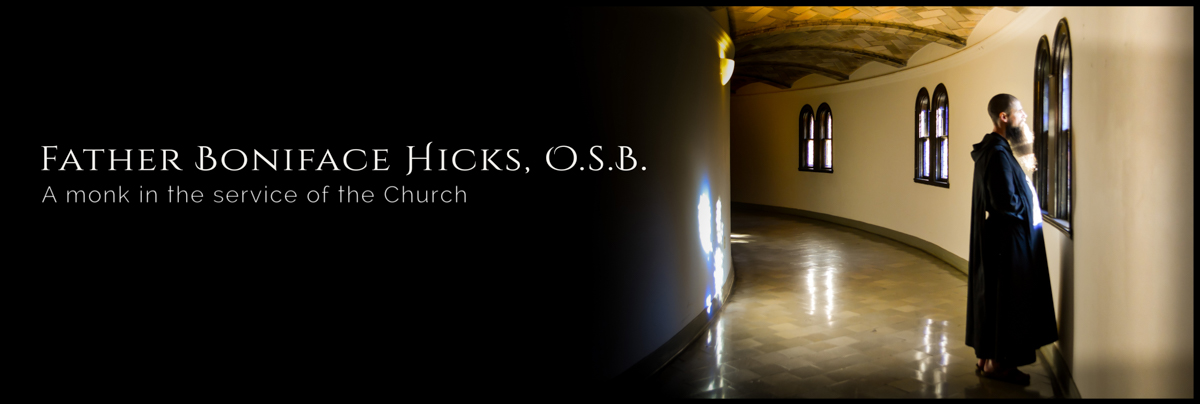

Rod Dreher proposed “The Benedict Option” as a way to move forward in our challenging times. He described how the Rule of Saint Benedict provides the culture-changing wisdom that could create a leaven to transform our world from the ground up. In my own reflections, it seems to me that Saint Benedict actually promotes “The Joseph Option.” His wisdom for monasteries helps them to become another Nazareth where we live the lives of Mary and Joseph always in the presence of Jesus. In Nazareth, the Gospel principles were lived out in such an unremarkable way that the locals were shocked when Jesus declared himself to be the Messiah (cf. Luke 4). And yet the Gospel principles were lived out in such a powerful way that God himself was always fully present, and it became the starting place of a new creation.
We can see the connections of Benedict and Nazareth in several ways. A Benedictine monastery is founded on the vow of stability so that the collective holiness from living out God’s will steadily permeates the place and it becomes an oasis of peace for visitors. I like to imagine that Nazareth was quite a peaceful place to visit and that the Holy Family was a wonderful model of hospitality in the decades they dwelt there. In a Benedictine monastery, the keynote is found in chapter 19 of the Rule: “We believe that the divine presence is everywhere . . .” and the orientation of everything in the monastery fosters greater awareness of that fact. In Nazareth, Mary and Joseph helped each other remember that their little boy was the Incarnate Word of God and they did everything in the divine presence. Saint Benedict described the monastery as a “school for the Lord’s service” (RB Prologue 45) and Pope Saint Paul VI described Nazareth as “the school in which we begin to understand the life of Jesus. It is the school of the Gospel” (Homily 5 January 1964 in Nazareth).
At Saint Vincent, we have another Nazareth where countless people have come in the last 175 years to enter into the divine presence. In the peace that comes from the first moments on the grounds to encounters with the various residents and finding a high point in the Basilica and the liturgy, hearts are changed, love grows, the Gospel is internalized and our world is improved a little bit at a time. It is providential that the Year of Saint Joseph coincides with our 175th anniversary. As we approach Father’s Day let us invoke our fathers Saint Joseph and Saint Benedict to help us foster another Nazareth and bring Jesus more tangibly into our world, so that “in all things God may be glorified!” (Rule 57:9; based on 1 Peter 4:11).


St Catherine
the Culture Project


The Spirit restores our original beauty and fills us with his grace, leaving no room for anything unworthy of our love. The Spirit frees us from sin and death, and changes us from the earthly men we were, men of dust and ashes, into spiritual men, sharers in the divine glory, sons and heirs of God the Father who bear a likeness to the Son and are his co-heirs and brothers, destined to reign with him and to share his glory.
In place of earth the Spirit reopens heaven to us and gladly admits us into paradise, giving us even now greater honour than the angels, and by the holy waters of baptism extinguishing the unquenchable fires of hell.
Speaking quite literally, and also in harmony with the words of water and the Spirit, John the Baptist says of Christ: He will baptize you with the Holy Spirit and with fire. Since we are only vessels of clay, we must first be cleansed in water and then hardened by spiritual fire – for God is a consuming fire. We need the Holy Spirit to perfect and renew us, for spiritual fire can cleanse us, and spiritual water can recast us as in a furnace and make us into new men.

“For you deal here above all with human life, and human life is sacred; no one may dare make an attempt upon it. Respect for life, even with regard to the great problem of the birth rate, must find here in your Assembly its highest affirmation and its most rational defense. Your task is to ensure that there is enough bread on the tables of mankind, and not to encourage an artificial control of births, which would be irrational, in order to diminish the number of guests at the banquet of life.”
Pope St Paul VI
.

